

Your Face Has Muscles. Here's How to Work Them Out!
Your Face Has Muscles. Here's How to Work Them Out!
There's a moment in the treatment room I've seen hundreds of times, when a client catches a glimpse of herself mid-microcurrent session and goes quiet. Not because she looks strange. Because she looks more like herself. Lifted. Alert. Brighter. Like the version of her face that exists in her memory finally showed up in the mirror again. After 25+ years in skincare, that moment still moves me every single time.
If you've been noticing that your face looks a little more tired than you feel, that your jawline has softened, that the apples of your cheeks seem to have drifted south, this post is for you. Not because something is wrong with you. But because something is very, very fixable.
What Actually Happens to Facial Muscles as Estrogen Declines
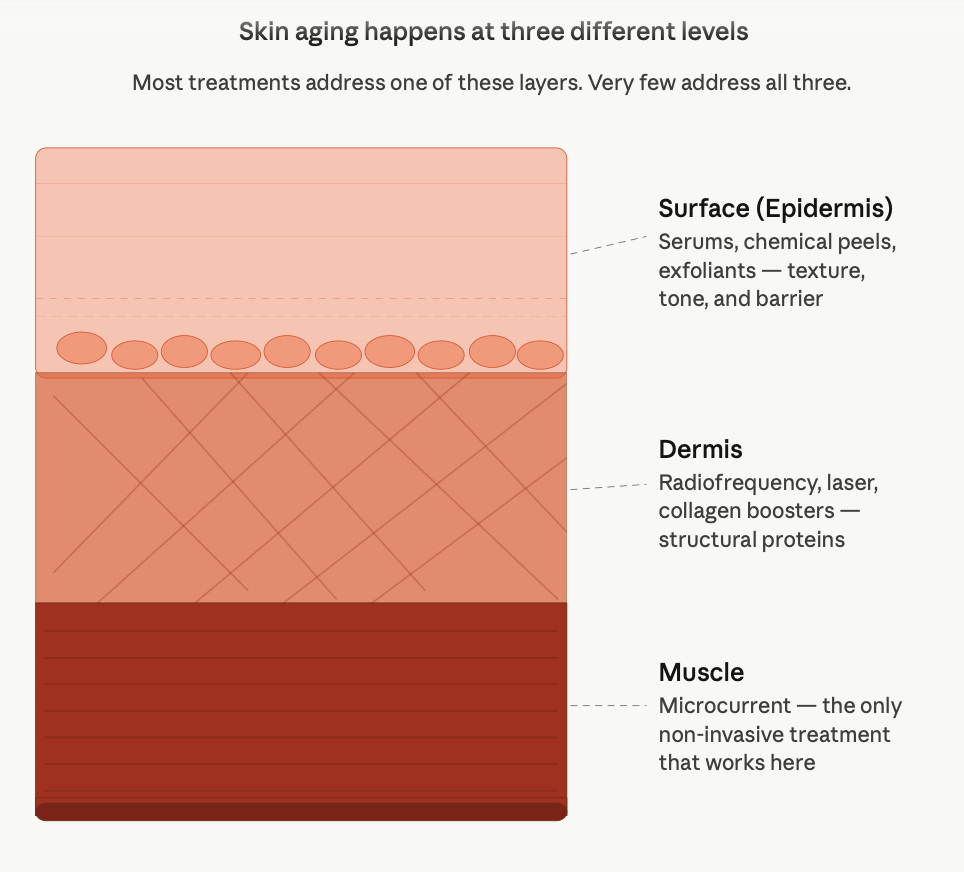
We talk endlessly about collagen loss during menopause, and rightly so. Estrogen decline reduces skin collagen by up to 30% in the first five years after menopause. But here's what we don't talk about enough: the muscles beneath the skin are also losing tone, volume, and electrical vitality.
Your face has 43 muscles. They lift your brows, define your cheekbones, sculpt your jawline. And just like the muscles in your body, they atrophy when they're not stimulated or when the hormonal environment that supported their tone begins to shift.
The result isn't just surface-level sagging. It's a structural change. The scaffolding underneath the skin is getting softer, which is why no amount of moisturizer, no matter how luxurious, will fully reverse what's happening.
Why Menopausal Skin Is Different — From the Inside Out
During perimenopause and menopause, the drop in estrogen and progesterone affects nearly every layer of skin function, circulation slows, cellular energy (ATP) production decreases, and the skin's ability to synthesize proteins like collagen and elastin diminishes. This is why the skin can feel simultaneously drier and less firm. It's not one problem. It's a cascade.
Understanding this changes everything about how we approach treatment. The goal isn't just to moisturize the surface. It's to re-energize the cells underneath.
The Inside-Out Angle: Why Cellular Energy Is Everything
Here's something I find endlessly fascinating: every cell in your body, including every skin cell, runs on a molecule called ATP (adenosine triphosphate). ATP is cellular fuel. When ATP production declines, cells can't repair themselves as efficiently, can't produce collagen on schedule, can't hold on to moisture the way they once did.
Microcurrent technology works precisely at this level. The low-level electrical current mimics the body's own bioelectrical signals, stimulating the mitochondria to produce more ATP. Clinical research suggests this effect can increase cellular ATP by up to 500% and, with it, protein synthesis (collagen and elastin) by up to 73%.
This is not a surface trick. This is a metabolic intervention.
I often tell my clients: think of microcurrent the way you think of strength training. You wouldn't expect a single gym session to transform your body. But consistent effort, two, three times a week, builds real, lasting structural change. Your face responds the same way.
The Device I Use on Myself and on My Clients
I want to be real with you: I've tried a lot of devices over the years. Some were disappointing. Some were fine. The MyoLift™ Mini Microcurrent Device is the one I actually keep using.
I use the professional version in my treatment room, and the Mini at home on myself a few times a week.
Why the MyoLift Mini Stands Out
What sets the MyoLift Mini apart is its dual-wavelength technology, which precisely adjusts microcurrent frequencies to target specific facial muscles- not just blanket stimulation, but targeted lift, tone, and sculpting. It delivers up to 400 microAmps, which is the range that mirrors the body's natural bioelectrical current without causing lactic acid buildup (which can lead to muscle fatigue rather than toning).
It's FDA-cleared, compact, rechargeable, and designed to work with conductive gels and masks for hands-free treatment options. The brand has been refining this technology for over a decade, and it shows.
Clinical-level results it's associated with:
- Up to 35% improvement in circulation
- Up to 73% increase in collagen and elastin synthesis
- 40% better nutrient absorption by skin cells
- 500% increase in cellular ATP
The MyoLift Mini is available at KismetK, and I'll walk you through exactly how I incorporate it below.
You'll also want to pair it with a high-quality conductive gel and, ideally, a targeted serum for post-treatment application, because one of microcurrent's most underappreciated benefits is that it dramatically enhances serum absorption. Whatever you apply right after a session goes deeper and works harder. This is the moment I reach for a peptide-rich or collagen-boosting serum from KismetK's curated skincare collection.
My Personal Take: Think of It as Self-Care, Not Another Chore
I hear it all the time: "Karina, I'm already overwhelmed by my routine. I can't add one more thing, life and all."
I understand. I genuinely do. But here's the reframe that changed everything for me and for so many of my clients:
Microcurrent isn't a chore. It's a workout for your face, and the ultimate act of self-care.
I do my sessions while I'm watching something on my iPad, or when the house is quiet. It takes 15–20 minutes. I glide the probes along my jawline, lift across my cheekbones, work the brow area. It feels like something. Not painful, pleasurable, actually. There's a kind of ritual to it.
And here's what I've noticed after consistent use: my skin looks awake, even on mornings when I haven't slept well. The definition in my jaw is back. The hollows under my cheekbones have softened. My serums seem to work better.
One of my longtime clients took her device on vacation and left it in her suitcase for two weeks. When she came back, she told me, "Karina, I could feel the difference after just two sessions back. I'll never leave home without it again."
That's the thing about microcurrent: once your muscles know what engaged feels like, they remember. And the consistency compounds.
This is the kind of self-investment that I believe is part of a larger journey, not just skin transformation, but the practice of showing up for yourself. Of learning what your body responds to. Of refusing to accept that "this is just what aging looks like" when there's so much you can do. That philosophy is at the heart of everything we do at KismetK.
"Your face has 43 muscles. When you give them the electrical signal they're no longer making enough of on their own, they remember exactly how to lift."
Frequently Asked Questions
Q: How often should I use a microcurrent device to see results? A: The MyoLift Mini is recommended 2–3 times per week for best results. Most women start noticing improvements in skin tone and firmness after 4–6 weeks of consistent use, with more significant changes building over 3–6 months. Think of it like a gym routine, the results compound with time.
Q: How do I use the MyoLift Mini at home? A: Start with clean skin, apply a conductive gel to the treatment area, and slowly glide the probes along your targeted areas — forehead, cheeks, jawline, neck. For a lifting effect, use the "pinch and hold" technique on areas prone to sagging. Sessions typically run 15–30 minutes. Do your best. The device comes with a training manual, and the brand offers video tutorials to guide beginners step by step.
Q: What's the best product to use with a microcurrent device? A: You'll need a good conductive gel to allow the microcurrent to penetrate properly; this isn't optional- it's functional. After your session, apply a high-quality serum while your skin is in a heightened absorption state. I love pairing the MyoLift Mini with peptide or collagen-boosting serums from KismetK — the post-microcurrent window is when they work hardest.
Q: Is microcurrent safe for menopausal skin, including sensitive or thinning skin? A: Yes. Microcurrent technology is non-invasive and gentle, working at a cellular level without irritation or downtime. The MyoLift Mini is safe for all skin types, including sensitive skin. If you have any implanted electronic devices (pacemakers, for example), consult your physician first. Otherwise, this is one of the most skin-friendly anti-aging technologies available.
Q: Will results disappear if I stop using it? A: This is the question I wish more people asked before they start. The honest answer: yes, to a degree. Microcurrent tones facial muscles the way exercise tones body muscles; if you stop, the muscles gradually return to their previous state. One of my clients noticed regression after just two weeks off. The good news: results come back quickly once you resume. This is a long-term practice, not a one-time fix.
Q: Can I use microcurrent in addition to my other skincare treatments? A: Absolutely, and it often enhances them. Microcurrent pairs beautifully with topical actives (retinoids, peptides, vitamin C) because of its absorption-boosting effect. I do recommend spacing it away from any active resurfacing treatments (chemical peels, laser) while your skin is healing. For a personalized protocol, a virtual consultation with me through KismetK is the best place to start.
Q: I'm in my early 40s and don't have significant sagging yet. Is microcurrent worth it? A: This is my favorite question, because the answer reveals so much about the difference between reactive and preventive skincare. Starting microcurrent before significant muscle atrophy has occurred means you're building and maintaining tone, not trying to recover it. The women I see who start in their early 40s consistently look the most naturally vibrant in their 50s. Think of it as the skincare equivalent of starting strength training before you need to.
The Bottom Line
Menopausal skin changes are real; they are structural, and they respond beautifully to the right interventions. Microcurrent technology, particularly the MyoLift Mini, which I use myself and recommend at KismetK, addresses one of the most overlooked aspects of facial aging: muscle atrophy and declining cellular energy.
Two to three sessions a week, 15–20 minutes, consistently over months- that's the equation. Not magic. Not overnight. But real, compounding, visible change in the structure and vitality of your skin.
My philosophy has always been that the skin reflects the whole self. When we invest in practices that work at a cellular level, that honor the intelligence of the body and work with it rather than against it, we're not just changing how we look. We're changing how we relate to ourselves.
I'd love to help you build a protocol that's right for your skin, your life, and where you are in this journey.
→ Book a Virtual Consultation with Karina → Take the KismetK Skincare Quiz
About Me! Karina is the founder of KismetK and a skincare and whole-body wellness expert with 25+ years of experience. Her inside-out philosophy addresses the root causes of skin changes during menopause and beyond.
As always; Tons Of Skin Love Your Way! K

Comments